
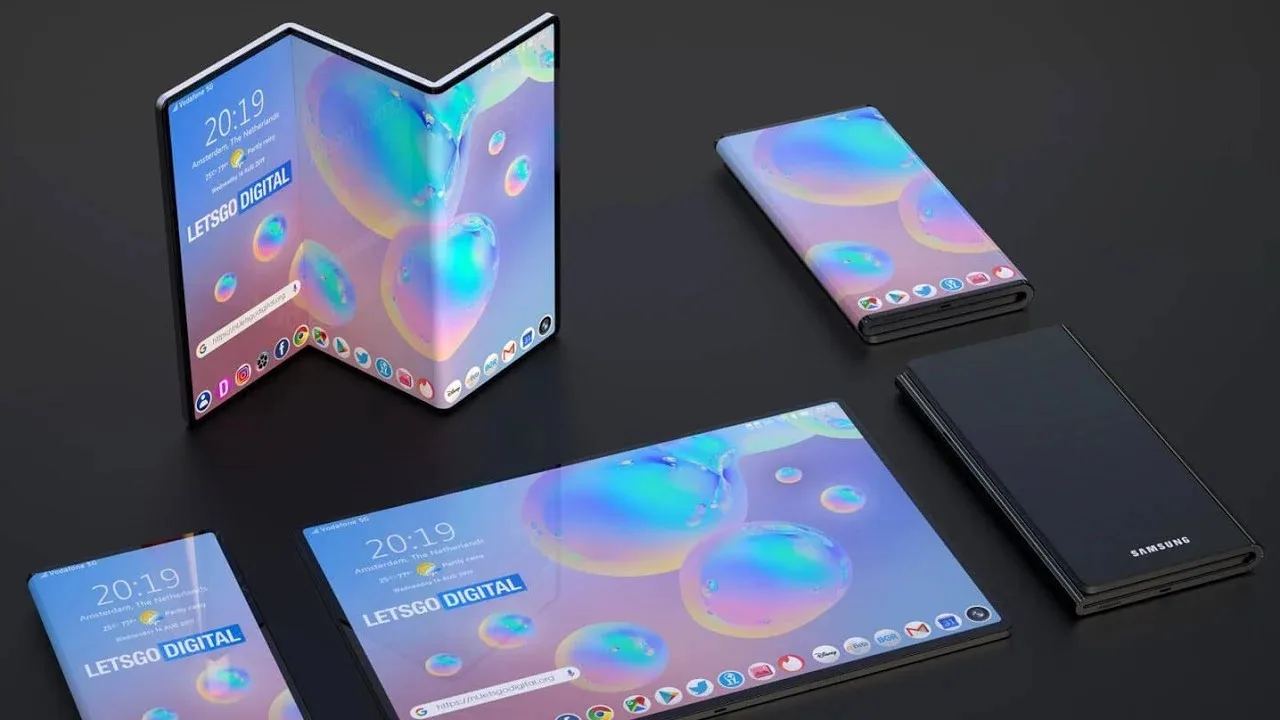
The introduction of the Samsung Galaxy Z TriFold marks a pivotal shift in mobile device architecture, moving beyond conventional foldables to establish an entirely new ultra-premium tier of portable computing. This device represents Samsung’s bold declaration that a single smartphone chassis can fully encompass the utility of both a phone and a large-format tablet, specifically targeting productivity and enterprise professionals who demand maximum screen space.
I. The Strategic Context( Samsung Galaxy Z TriFold): Defining the Ultra-Premium Mobile Frontier
The Evolutionary Leap: Bio-Fold to Tri-Fold Paradigm Shift.
Samsung has been a market leader in the foldable segment with its Z Fold and Z Flip models, which uses the Flex Hinge to turn a phone into a small book-shaped tablet. The shift towards the tri-fold design is a design imperative, and it is solving the shortcoming of the bi-fold design that cannot provide an actual 10-inch tablet experience. In order to reach this size threshold and allow sophisticated professional processes, a three-segment, dual-hinged design was created.
This fresh form factor is conceptually tied to designs that Samsung Display had already conducted research on, namely the so-called Flex G prototype that folds twice. The Galaxy Z TriFold has the last design with a dual-hinge, in-folding design, which, upon closing, both outer parts fold inwards to completely cover the main flexible OLED screen. This internal folding structure puts a lot of emphasis on display durability and protection- a crucial factor with the complexity and exceptionally high cost of this design involving the manufacture of three interconnected flexible display segments and the hinge mechanisms.
Formal Roll-out and Strategy Story.
The official release of the device was an extremely carefully planned and managed event. It was publicly displayed at the K-Tech Showcase, an off-the-record event of the APEC 2025 Summit in Gyeongju, South Korea. This is a strategic location that it placed the device not as a conventional consumer product, which normally gets announced at a Galaxy Unpacked event, but as a significant technology declaration.
The launch of the device during the Asia-Pacific Economic Cooperation summit makes the TriFold one of the major innovations that shall target the captains of the industry, the government, and upscale enterprise customers. This framing introduces the TriFold as a fundamental innovation in the next generation form factors in the age of mobile AI. Although the first unveil was an inactive physical display, enclosed in glass, a store launch is highly expected, and an online-only Unpacked event has been suggested to take place at the end of October.
The Tri-Fold Arms Race Benchmarking the Competition.
Although Samsung is establishing a presence of the global market dominance in foldables, it is not the first corporation to launch a triple-folding device. Chinese manufacturers have led with the tri-fold segment, with Huawei launching its Mate XT, a costly model that had previously only been available in China, and concept models presented by Tecno.
The globalization of the tri-fold category is the response to this competitive pressure by Samsung. The implementation of Samsung balances on the vast experience of hinge mechanisms and optimization of displays to provide high-quality software integration and stability and create a new world standard in the category.
II. Architecture and Hardware Mastery: Designing a Fresh Canvas.
The Galaxy Z TriFold case is characterized by an unprecedented level of intricacy in its technical basis as it incorporates three expensive display panels, as well as two strong hinge mechanisms. The main reason Samsung should have an ultra-premium positioning is that it has managed to create this combination at a stable user experience.
The Evolutionary Leap: Bio-Fold to Tri-Fold Paradigm Shift.
Samsung has been a market leader in the foldable segment with its Z Fold and Z Flip models, which uses the Flex Hinge to turn a phone into a small book-shaped tablet. The shift towards the tri-fold design is a design imperative, and it is solving the shortcoming of the bi-fold design that cannot provide an actual 10-inch tablet experience. In order to reach this size threshold and allow sophisticated professional processes, a three-segment, dual-hinged design was created.
This fresh form factor is conceptually tied to designs that Samsung Display had already conducted research on, namely the so-called Flex G prototype that folds twice. The Galaxy Z TriFold has the last design with a dual-hinge, in-folding design, which, upon closing, both outer parts fold inwards to completely cover the main flexible OLED screen. This internal folding structure puts a lot of emphasis on display durability and protection- a crucial factor with the complexity and exceptionally high cost of this design involving the manufacture of three interconnected flexible display segments and the hinge mechanisms.
Formal Roll-out and Strategy Story.
The official release of the device was an extremely carefully planned and managed event. It was publicly displayed at the K-Tech Showcase, an off-the-record event of the APEC 2025 Summit in Gyeongju, South Korea. This is a strategic location that it placed the device not as a conventional consumer product, which normally gets announced at a Galaxy Unpacked event, but as a significant technology declaration.
The launch of the device during the Asia-Pacific Economic Cooperation summit makes the TriFold one of the major innovations that shall target the captains of the industry, the government, and upscale enterprise customers. This framing introduces the TriFold as a fundamental innovation in the next generation form factors in the age of mobile AI. Although the first unveil was an inactive physical display, enclosed in glass, a store launch is highly expected, and an online-only Unpacked event has been suggested to take place at the end of October.
The Tri-Fold Arms Race Benchmarking the Competition.
Although Samsung is establishing a presence of the global market dominance in foldables, it is not the first corporation to launch a triple-folding device. Chinese manufacturers have led with the tri-fold segment, with Huawei launching its Mate XT, a costly model that had previously only been available in China, and concept models presented by Tecno. The globalization of the tri-fold category is the response to this competitive pressure by Samsung. The implementation of Samsung balances on the vast experience of hinge mechanisms and optimization of displays to provide high-quality software integration and stability and create a new world standard in the category.
II. Architecture and Hardware Mastery: Designing a Fresh Canvas.
The Galaxy Z TriFold case is characterized by an unprecedented level of intricacy in its technical basis as it incorporates three expensive display panels, as well as two strong hinge mechanisms. The main reason Samsung should have an ultra-premium positioning is that it has managed to create this combination at a stable user experience.
Form Factor Dynamics: Pocket Phone to Tablet XL.
The Galaxy Z TriFold is designed based on a dual-hinge structure, which was developed to provide durability and the virtually seamless motion that is synonymous with up-to-date Flex Hinge technology. The in-folding design with dual hinges enables the device to pass through the three different and functional forms:
Closed (Smartphone Mode): The phone becomes a standard smartphone form with a 6.5-inch cover on which one can use with one hand.
Partially Unfolded (Intermediate Mode): With an expansion of one segment, you get an 8-inch screen, which offers an unorthodox yet viable surface area to carry out a few tasks in no time.
Fully Unfolded (Tablet XL Mode): Fully opened, the device has a huge main screen size of 10 inches and in some estimates, it goes up to 10.8 inches. This is a very large size compared to the 8-inch displays that are currently available on the foldables in book format, and it gives the canvas needed to be productive at the desktop level.
The Snapple Paradox: Dispersed Battery Innovation.
The physical design that incorporates two hinges that cut the body does not allow the integration of a single high-capacity battery. This prompted Samsung to come up with a highly advanced, compartmentalized power system that is described in confidential patent applications.
A design using three distinct physical battery components of different shapes and variations of the thickness is verified by patent sketches. These cells are spaced out well: the smallest one is close to the camera housing, the second-largest is located in the main fragment, and the largest one is in the third fragment. The system is supposed to reach a total capacity of over 5000mAh, which is vital in as far as powering the large high-resolution OLED screen is concerned.
The phone is also said to be using high-density silicon-carbon battery technology. This high-tech chemistry is critical because it enables Samsung to squeeze additional useful energy into the limiting, geometrically confined spaces formed by the two hinges and the folding screen, addressing the overarching engineering dilemma of finding the balance between portability and battery life. Since this battery system is rather interconnected, it is apparently difficult to charge it with wires, which means that the charging speed is limited to a conservative 25W to focus on safety and the lifespan of the components rather than competition in the battery in the first generation.
Basic Requirements and Inbuilt Functionalities.
Galaxy TriFold is also reported to have the Snapdragon 8 Elite chipset, the high-end processor of the last generation. This option implies that Samsung was convinced that attaining the form factor stability and software functionality optimization were more important than incorporating the very latest peak performance hardware into this experimental launch. It is assumed that the camera will match the high-end offerings of Samsung, such as a 200Mp primary camera and 100x digital zoom.
In terms of the interface, there are leaked animations that indicate that fundamental functionality (NFC and wireless charging which is Qi2-specific) has been implemented into the right-hand panel, which serves as the major exterior interface when the gadget is either closed or partially extended.
The desired specifications and business plan might be summarized as the following:
| Feature/Metric | Specification / Detail | Implication |
| Main Display Size | 10.0 – 10.8 inches (OLED) | Enables a true tablet replacement form factor |
| Folding Mechanism | Dual-Hinge, In-Folding (Flex G-like) | Enhances screen protection and complexity |
| Chipset (Rumored) | Snapdragon 8 Elite (Last Gen) | Focus on design stability over maximum speed |
| Battery Architecture | Segmented Three-Cell System | Innovative solution for power density |
| Software Differentiator | True 1:1:1 Three-App Concurrency (One UI 8) | Essential feature justifying professional positioning |
| Estimated Price (USD) | $2,780 – $3,500 | Ultra-premium, niche market positioning |
| Initial Volume (Units) | 50,000 – 200,000 | Extreme caution and market testing strategy |
| Initial Launch Markets | SK, China, UAE, Singapore, Taiwan | Focus on high-value, high-demand Asian luxury markets |
III. The Software Experience: One UI to the Desktop Era.
The operating system of the Galaxy Z TriFold supports the complexity of the hardware issue of the device completely. One UI 8 is modified into a single-pane and multi-pane display with a customized version that turns the smartphone into an integrated and productive workstation.
Three Apps, One Screen The New Multitasking Standard.
The greatest software improvement is the use of actual side-by-side 3-application concurrently. Book-style foldables that are currently available can only hold two (sometimes three) full-screen applications, and frequently a third is placed within a limiting quadrant. The TriFold enhances this limitation by its wide 10-inch canvas where users are able to run three full applications at the same time each equally-sized, and comfortable in a portrait split.
This feature will essentially transform the working process of the professional on the portable device. Multitasking, like using a document editor, being involved in a video call, and using a web browser at the same time, becomes truly possible. This amount of simultaneous workflow warrants the device to be placed as a serious professional tool. Solving the three-panel concurrency problem, Samsung will establish a precedent in the whole ecosystem, and will cement control over the future of the portable OS design.
Context-Aware Windowing and persistence.
The experience on the software is created to allow seamless continuity of application. Applications on the smaller 6.5-inch display cover automatically change and revert to the desktop when the device is fully unfolded.
The operating system is said to have built-in context-sensitive windowing. This aspect is relevant in the sense that customized application-specific three-app layouts are remembered and immediately called into recollection under different folding and unfolding conditions. The interface also works to blur the distinction between the mobile and desktop by providing the persistent taskbars and desktop views of applications, being highly indicative of more integrated operations with Samsung DeX and making the TriFold even a more potent portable computing device.
Galaxy AI on a Grand Scale
The larger display size greatly increases the functionality of inbuilt AI capabilities. Leaked animations indicate that Galaxy AI can take almost half of the enormous display when called upon to perform an analysis or provide support on a real-time basis. This graphic feature enables the users to utilize more complex AI, like that embedded into the Samsung Internet module, without covering the main application. This is a smooth, large-scale deployment of AI services that contributes to the overall mission of the TriFold as the final productivity powerhouse.
IV. Market Penetration and Strategy of the commercial.
The Galaxy Z TriFold marketing strategy is characterized by excessive caution, great levels of exclusivity, and high-end price differentiation, in keeping with the template that Samsung has used to introduce high-risk, innovations.Price and Target Audience The Ultra-Premium Positioning.
The price of the Galaxy Z TriFold will be within the new ultra-premium pricing bracket and is estimated to be priced at approximately 2780 USD, and some industry analysts have estimated the pricing of the item to reach an even higher price (perhaps between 3000 and 3500 USD). This puts the device way above the launch price of the former Z Fold series.
The high price is equivalent to the bill of materials, which consists of three soft OLED panels, sophisticated high-density cabling system, reinforced, dual-hinge assemblies, and the complicated, segmented system of batteries. This is a very narrow market: high-end early adopters, top executives and the professional audience, whose business practices are uniquely enabled by the exclusive concurrency offered by the device.
Controlling Scarcity: Sparing Production as a Market Instruments.
Samsung is also said to be doing a very limited first production run with the production run estimated between 50,000 and 200,000 units. The market strategy is determined by this extreme caution.
This low starting lot size is a risk reduction strategy that is calculated, which acts as some kind of commercialized research and development (R&D). It enables Samsung to certify the very complicated production procedure of the dual-hinge and the massive, tri-sectional display parts. The controlled volume launch will enable the company to gather the much-needed durability information and measure correctly the actual market interest of high-paying consumers before investing in an expensive scale of mass production.
Geographic Strategy: Planting the Ecosystem.
Initial reports indicate a massively limited introductory rollout into some primary Asian markets: South Korea, China, Singapore, Taiwan, and the United Arab Emirates (UAE). Notably, it is mentioned that the first release in the United States seems unlikely to occur.
This is a logical geographic selectivity. These Asian markets are strong luxury mobile hardware consumers, and they have more penetration of foldable phones than any other region of the world; hence their ideal proving ground of such an costly and experimental gadget. This will enable Samsung to pre-cultivate a market full of specialty accessories and productivity application optimization to fit the specialized three-window architecture before trying a global push that requires resource consumption.
V. Outlook and Investment Implication.
The Galaxy Z TriFold is a landmark product, indicating the point of departure in the perception of the boundaries of mobile devices.
Long-term Competitive Effect.
The large size of the screen (10-inch) and the ability to multitask of the TriFold makes it a direct competitor to the high end, single purpose 10-inch tablets and competes directly on the dominance of ultra-lightweight 11-inch portable laptops. To the enterprise user, pocketability coupled with a desktop-like concurrent processing is a very attractive alternative to multiple devices in one. Should this work out, the TriFold will greatly enhance the software ecosystem at Samsung, motivating third-party developers to support and customize their apps to three-window layouts and thus set the precedent of large-screen Android devices to come.
Future Dependencies and Critical Forecasts.
Long-term hinge durability is important to the long-term commercial viability of the tri-fold mechanism. Any subsequent development should prove that the dual-hinge can meet the same high standards of reliability that were seen with the previous Z Fold series. Also, it is reasonable that the first generation device was using a previous generation chipset but the next generations should rapidly adopt the latest flagship processors to keep up with the competition of high end non-foldable smartphones.
According to the classic Samsung approach of limited edition technology launches, mass production of the triple-folding shape is not expected until the second or third generation. This schedule would enable the cost of components to reduce and optimization of production to be made. The existing Galaxy Z TriFold has to be perceived as a necessary technological incubator.
Conclusion: The Ultimate Statement of Samsung on Mobile Convergence.
The Galaxy Z TriFold represents the engineering pronouncement on the Samsung part that the smartphone casing has the capability of assimilating the tablet sector into being and basically invade the portable PC territory. Located as an ultra-premium, specialty product whose entry price is very high and its initial production volume is extremely limited, its direct market presence will be limited. But its strategic importance is enormous.
The TriFold is an obligatory technological proving ground, both to next-generation components, namely the segmented battery architecture, and the sophisticated dual-hinge design, as well as game-changing software standards, including the reality of three-app simultaneous operation. Through adoption of these technologies within a controlled commercial setting, Samsung gains its competitive edge in the long run and determines the trend in which all the high-end mobile convergence device will take in future.