
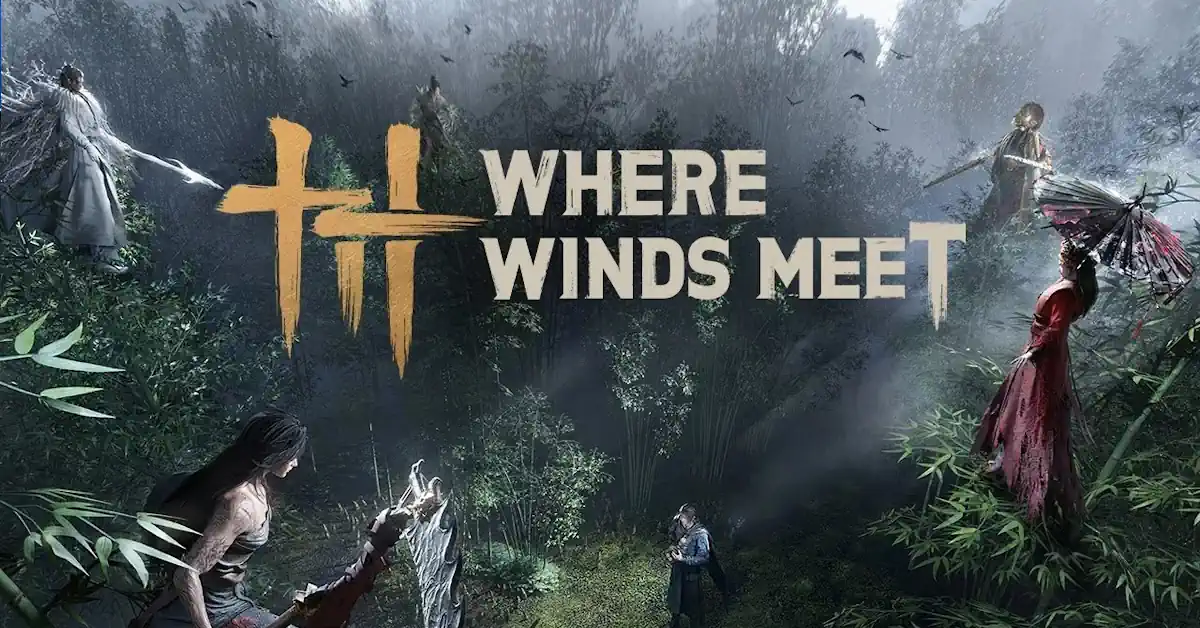
Where Winds Meet is a free-to-play (F2P), open-world action-adventure role-playing game (RPG) created by the studio of Everstone and published by NetEase, which is an ambitious and highly anticipated game. Played in the politically unstable Five Dynasties and Ten Kingdoms of 10th-century China, Where Winds Meet challenges the player to take on the role of an apprentice sword master who has to create a legend in a world where war was rampant and martial arts philosophical in nature.
Its fundamental strength, where Winds Meet, is its desire to fully capture the essence of Wuxia martial arts fiction with its mixture of martial arts prowess and Eastern philosophy and aestheticism that would have been absent in the more traditional martial arts fiction, such as Kung Fu. The game will be guaranteed to launch on PC and PlayStation 5 and is currently planned to do so on November 14, 2025.
I. Dynamic Combat: The Soul of Wuxia.
Where Winds Meet fighter has been created to be very fast, fluid and highly customized with an emphasis on the agility of the players, timing and defensive parrying. The philosophy of Everstone Studio is that weaponry is not only violence but the expression of both character and art.
1.1. The Two-Weapon System of Flexibility.
The major mechanic of the game is the two-weapon system, in which players can equip and alternate between two primary weapons, a spear, a sword, dual blades, a rope dart, or a mo blade, in combat. There is a weight and a feel to each weapon, so the combination of them is very important to the overall fighting style of the player and the possible combinations in the fights.
1.2. Arts and Crafts: The Ninefold Umbrella.
The umbrella (Ninefold Umbrella) as a weapon of killing is perhaps the most obvious example of the Wuxia aesthetic employed in Where Winds Meet. This impractical object is turned into something useful, namely, poetry in deadly motion, which can protect the gamer when open and hit like a knife when closed. This artistic feature makes fighting an artistic gesture and it is in accordance with the principles of the Wuxia genre.
1.3. Qinggong Traversal
Following the rule of the wuxia genre, mobility plays a very important role in Where Winds Meet. Qinggong (lightness skill) is used by the players to enable superlative traversal, which enables superhuman acts such as running, jumping, wall-running, quickly ascending vertical objects and dashing in the air. It is not merely an exploration movement system across the 20 regions of the game; it is actually a part and parcel of combat and stealth in which the system is a tactical tool.
II. Stratified Character Development Systems.
Where Winds Meet requires an elaborate progression architecture that necessitates synergistic construction among three specialized skill systems, which is a much more rigorous character leveling than mere character leveling.
2.1. The Three Arts: Martial, Internal, and Mystic.
Martial Arts: This is the active combat skill of the player, which is highly dependent on the weapon that he is using. As an illustration, the Nameless Sword has been solitarily offensive, whereas the Panacea Fan is devoted to the healing skills. The players are able to learn all martial arts but are limited to using four skills in each weapon they are armed with.
Internal Arts: These are highly important passive combat buffs, which come into effect during fighting. They are complicated by the fact that they require specialization, which is mandatory since many internal arts have to be in alignment with a particular type of martial art and weapon (e.g., Adaptive Steel can only work with a particular type of strategic sword or a particular type of strategic spear).
Mystic Arts: These are specialized skills, which have two purposes. They are combat strategies and are essential in solving puzzles, conquering exploration difficulties, and making movement complex. Players are allowed to have eight Mystic Arts at a time, both in and out of battle.
2.2. Profession-Specific Non-Combat Careers.
Sandbox liberty in Where Winds Meet is supported by confusing, non-combating job trajectories that provide intricate specialization.
Healer: Is involved with the diagnosis and treatment of NPCs and players of different ailments (wounds, diseases). The success of the different diagnostic meta-games is evaluated based on specialized attributes such as knowledge of muscles, organs, mind, and meridians, which form a complex diagnostic meta-game.
Scholar: Participants take part in academic activities, such as the most popular rhetoric debates and specialized non-combat RPG games. In verbal duels, defense is based on the statistics like Maximum Fallacy Tolerance and Maximum Rant Tolerance.
III. Free-to-Play and Free Open World Economy.
3.1. Freedom of Customs and Multiplayer Ecosystem.
Where Winds Meet is a large open world with more than 20 unique regions it can explore and provides the player with freedom to take part in detailed sandbox experiences, such as crafting weapons and armor, collecting resources, and a building system. The economic cycle enables players to sell custom-made goods in a black market that is unlocked through plot development.
Social identity is decided by the eight primary factions (such as the Midnight Guard or the Drunken Flower Pavilion) that dictate social structure. Standalone Sects are competitive Player-versus-Player (PVP) tournament groups that can include multiple players and include a competitive upgrade progression like the mainstream using the name ZhiGe, which also has its own upgrade system.
3.2. F2P Monetization Integrity
Where Winds Meet follows a free-to-play business model in which the main business focus is on cosmetic microtransactions without any pay-to-win power benefits. The Gacha system is based on premium cosmetic rewards, which include outfits, mounts, and skill effects.
The distinctive characteristic that aims to guard the player experience is the different pity counter system. The 150-pull guarantee on a high-value cosmetic product is followed separately on:
Bound (Free) tickets (farmable).
Gold (paid) tickets.
The given distinction is essential to ensure that even free-to-play progress is not washed down by little purchases of paid items, which underpins the belief that time spent by the players is valued in Where Winds Meet. There is also an option of trading unwanted gacha outfits with Eight-Tone Orbs, which is a premium currency and can be used to buy desired outfits out of a shop, avoiding the bad luck factor underlying the gacha system.


